

Your company has approved its AI policy, and employees know which tools they can use, what information they can share, and when approval is required.
That’s useful work, but you may still be unable to explain how a team should change its workflow, what its people need to contribute, or how their performance will be evaluated.
Acceptable-use boundaries answer part of the question, but a shared plan has to connect those boundaries to everyday work.
When HR’s involvement ends at policy, business and technical decisions can reshape responsibilities before anyone has joined up the workforce implications. A task gets faster, but review becomes someone else’s problem. Employees hear encouragement to experiment while wondering what their experimentation means for their jobs.
Two consequences deserve attention:
Useful local improvements may struggle to scale
Employee trust can erode as expectations change without a clear conversation.
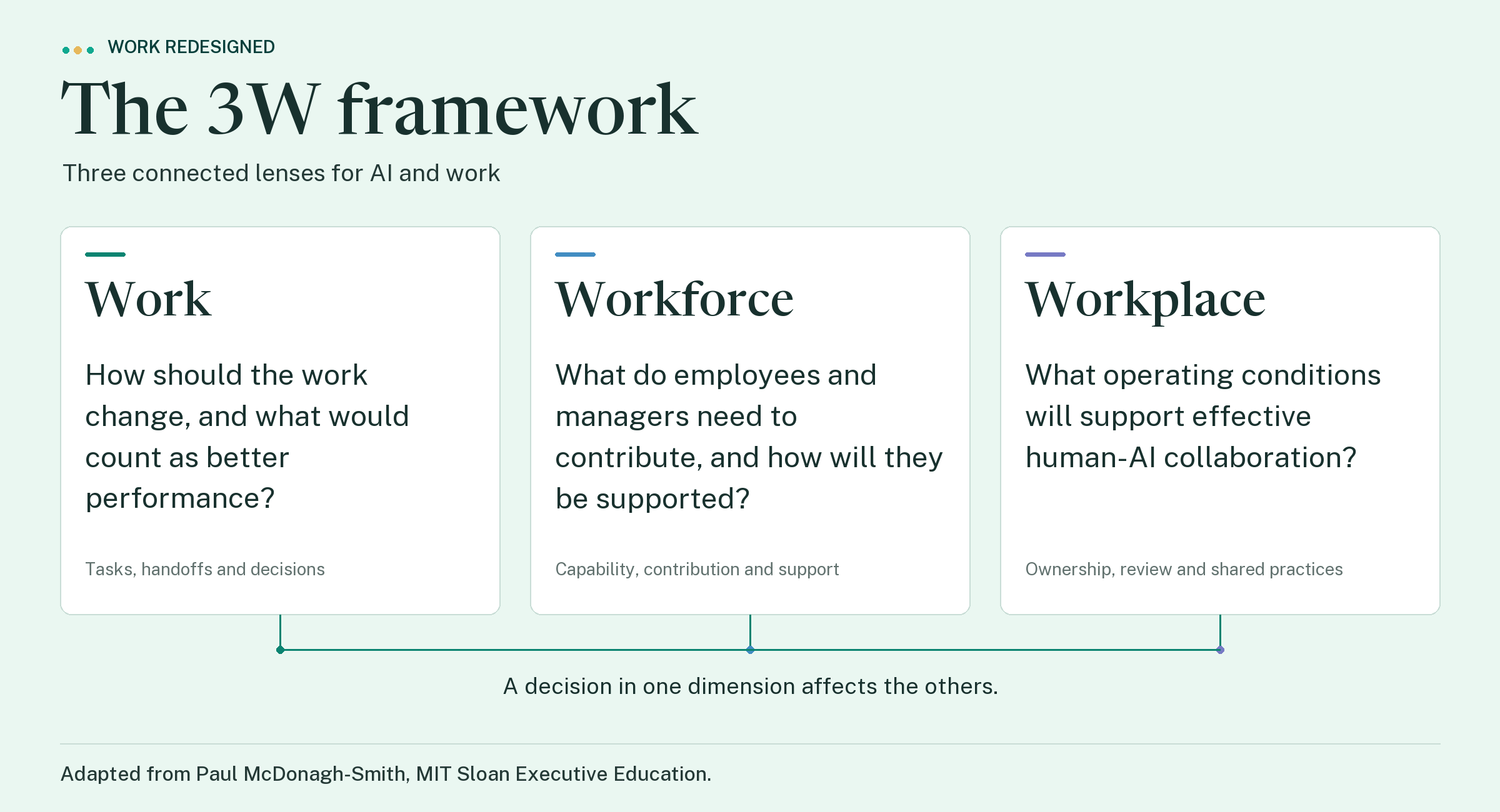
I think HR needs to lead that conversation, working with business and technical leaders on a shared plan. The framework I like to use when working with the role HR plays in AI is called the 3Ws: Work, Workforce, and Workplace. This framing gives HR leaders the language and advocacy points needed to steer the conversation from a People perspective while collaborating with fellow executive peers.
Work needs a plan for the whole workflow
Start with what the company needs to accomplish, then follow the work through its tasks, handoffs, decisions, and quality expectations. Within each workflow, ask:
What should remain human-led?
What AI can handle?
Where people and AI can work together?
Then decide where a person needs to exercise judgment, challenge an output, or make the final decision.
Imagine a hypothetical sales team that starts using AI to draft proposals. Drafting gets faster, so more proposals arrive with the commercial team for review. Nobody has agreed what evidence a draft should include, which commitments require checking, or how the next team will handle the extra volume.
Although drafting has improved in this example, its value across the workflow remains an open question.

Business leaders need to agree what changes upstream, what the reviewer receives, who approves exceptions, and how the downstream team uses the result.
Better performance might mean shorter time to an approved proposal, less rework, or more reliable commitments. Choose the measures that fit the business outcome.
McKinsey’s March 2025 report, based on 1,491 respondents across 101 countries, linked workflow redesign with greater self-reported financial impact from generative AI. That association supports looking beyond isolated tasks; it doesn’t prove redesign caused the gains.
The decision is how the workflow should change and what would count as better performance.
Have we agreed on how the work should operate with AI, or are individuals deciding for themselves?
Workforce contribution needs to be clear
Once the workflow changes, the capability conversation becomes specific.
While the proposal writer judges whether generated claims are supported, the reviewer may need to spot omissions, test assumptions, and explain why a plausible recommendation should be rejected. Responsibility needs to remain clear when several people and an AI tool contribute to the same output.
Tool training helps people get started, but role-specific judgment, accountability, and changing responsibilities still need deliberate attention.
In a 2023 experiment involving 758 BCG consultants, AI improved performance on tasks within its tested capabilities. On a task outside those capabilities, AI users were 19 percentage points less likely to reach a correct solution. Those results concern GPT-4 and the study’s tasks, rather than today’s tools generally. They illustrate why capability development should include deciding when and how to rely on AI.
Managers need support too.

When you give them work samples, agreed review standards, and time to coach, they have a practical basis for assessing the work. Otherwise, an important decision is left to personal interpretation.
What will someone be valued for as their responsibilities change?
For an employee whose professional identity rests on producing the first draft, a move toward review and judgment may need explanation, practice, and a credible development path.
Invite employee input before expectations harden, and be clear about what is decided and what remains open, including workload, role changes, and evaluation. Avoid promising certainty you don’t have.
Agree what employees and managers must be able to do and how they will be supported.
Can people explain their changing contribution, and do they have the capability and manager support to deliver it?
Workplace support needs to survive everyday use
The workplace question concerns ownership, decision rights, review, support, and escalation. Policy belongs here alongside the practical arrangements people need when something goes wrong.
In another hypothetical example, an employee builds a useful tool that summarizes internal requests, and colleagues begin using it regularly. Then its creator takes leave. Nobody can explain who maintains it, who reviews changes, or where users should report an unreliable result.
Before wider use, agree who owns the tool, what needs review, how support works, and when use should pause. Make room for shared experimentation and learning so colleagues can compare results and resolve questions together.
Check incentives as well. If people are encouraged to improve a shared tool while being evaluated entirely on their existing workload, that extra responsibility needs an explicit decision.
These arrangements support scaling and give employees clearer grounds for trusting how the work is managed. Decide what operating conditions will support effective human-AI collaboration.
When an experiment becomes part of everyday work, can we name who owns it, how it is reviewed, and where people get support?
HR connects decisions across the 3Ws
HR leads the workforce conversation and connects its implications to the wider plan. Business leaders own workflow decisions and business outcomes. Technical leaders own technical decisions and support requirements. Relevant risk specialists contribute where needed.
A change to proposal drafting may require new review capabilities, manager guidance, and a support process, so those decisions need to be made together, with employee input.
For each W, ask what decisions have been made, who owns them, and what evidence shows they are happening in practice.
Choose one AI experiment already happening in your company. Can you explain how the work is changing, how people are being prepared, and how the workplace supports it?
Sources
1. Paul McDonagh-Smith, MIT Sloan Executive Education. From AI Adoption to Adaptation in Work, the Workforce, and the Workplace, January 13, 2026. Teaching source for the three lenses; the diagnostic questions here are my application.
2. McKinsey/QuantumBlack. The state of AI, March 12, 2025. Survey of 1,491 respondents across 101 countries; fieldwork conducted in July 2024.
3. Dell’Acqua and coauthors. Navigating the Jagged Technological Frontier, HBS Working Paper 24-013, 2023. Randomized experiment with 758 BCG consultants using GPT-4.
4. Lane, Williams, and Broecke. The impact of AI on the workplace, OECD, 2023. Surveys of 5,334 workers and 2,053 firms in manufacturing and finance across seven countries; fieldwork conducted in 2022.
5. MIT Sloan Office of Communications. Why some organizations turn AI experiments into business value while others quietly fail, September 9, 2026. Institutional report of a two-year field study of two organizations by Kellogg, Wiesenfeld, and Karunakaran.