


People across your organization are using AI to prepare drafts, analyze information, and handle tasks differently. Yet when someone asks, “What’s actually happening across the business, and what is this work turning into?” you find yourself reaching for examples without a clear account of what they add up to.
You can describe the activity from what you’ve heard, but explaining where it is taking the organization is harder.
For an HR leader, that uncertainty has practical consequences: you may be supporting employees through changes whose implications for their roles are still unresolved, while the decisions about processes, systems, and authority sit across several parts of the business. How do you help people develop for work that leaders haven’t yet described clearly?
The distinction between Work, Workforce, and Workplace, described by Paul McDonagh-Smith at MIT Sloan, gives you a way to examine the moving pieces. He emphasizes their interdependence; looking at them together helps you connect changes in tasks to changes in people’s contribution and the environment that supports both.
In this framing, Work concerns what gets done and how it produces a business result. Workforce concerns the people whose capabilities, responsibilities, and professional identities are changing. Workplace concerns the physical, organizational, and digital conditions in which that work happens.
Those distinctions can help you describe what is changing now, identify what remains unresolved, and consider how the organization could develop from scattered activity into a more deliberate way of working. Here’s how I would bring them to a leadership conversation.
Work: what changes between the task and the business result?

The Work lens follows a task into the decisions and handoffs around it, so you can examine how an AI-assisted output contributes to the result the business needs.
Consider a hypothetical customer-onboarding team in which AI helps prepare an account summary before Sales hands a customer to Implementation. Describing the change as “AI writes the summary” tells you what happens at one point in the workflow. The more consequential question is whether the receiving team can understand the customer’s requirements, recognize what Sales has promised, and decide how to proceed.
Following the summary through that handoff could reveal several design questions:
Which details need to be checked against their sources?
How will uncertainty appear in the document, and who can resolve a promise that conflicts with the implementation plan?
If the receiving person has to repeat the research, you also have a question about how context travels between teams.
Each answer affects how responsibility is divided among people and AI. You might use AI to assemble the information while a specialist checks a consequential claim, then bring a conflicting commitment to the person authorized to resolve it. That allocation deserves examination alongside the business result, because a change in preparation can alter what everyone downstream is expected to do.
The question I would bring to the discussion is:
What changes in the workflow when someone uses AI, and what business result are we examining?
An actual handoff or decision record can make this discussion more useful than a general account of tool use. People can follow the same example and see where their assumptions differ.
Workforce: what are people being asked to contribute now?

Once you examine how the workflow changes, a second question follows: what does the new design ask of the people doing it?
In the onboarding example, an implementation specialist might have built their reputation on gathering scattered information and preparing a thorough account brief. As AI takes on some of that preparation, the person may welcome the help while wondering what will make their contribution valued in the revised role.
“Use the time for higher-value work” leaves that question largely with the employee.
If the specialist is expected to recognize a mismatch between customer expectations and the implementation plan, the organization needs to make that responsibility concrete.
The person will need to understand the business context, practice weighing uncertain information, and learn how to explain a concern to colleagues who may see the situation differently. Their manager also needs a way to recognize and support that contribution.
This is where I want development to sit: inside a real business problem, with affected employees helping shape the responsibilities they are growing into.
A specialist could compare an AI-prepared brief with the underlying account information, discuss the options with a manager, and revisit the reasoning as more becomes known.
Guided discovery gives the person an opportunity to learn through the work itself.
There is a personal dimension too.
A familiar task may have provided pride, status, or a sense of being useful; when it changes, an employee can lose something they valued before they can see a credible next contribution. Asking about that experience can help leaders understand what the redesigned role needs to offer.
The Workforce question is:
What contribution are people growing into, and where will they get to practice it?
A useful answer would connect the revised responsibility to an opportunity for practice and the support needed to carry it. Training can contribute, while the role gives that learning somewhere to go.
Workplace: what makes the new way of working possible?
The redesigned workflow and the employee’s growing capability depend on the environment around them. Workplace brings that environment into view, including the physical setting, organizational structure, digital tools, information, and decision authority.
Suppose the specialist in our hypothetical example is expected to flag conflicting commitments, but Implementation cannot access the original Sales information. Even when the person identifies a concern, several managerial approvals may stand between them and someone who can resolve it. The new responsibility now depends on access and authority that the organization has yet to provide.
That creates a leadership decision.
The same lens can help you examine whether the organization makes room for learning and collaboration.
A manager may want employees to develop judgment while their schedules leave little time to review an exception; a team may be encouraged to work across functions while its tools separate the context each function needs. Physical space and digital arrangements can either support those interactions or make them harder to conduct.
For HR leaders, these dependencies create a reason to involve operational and technology colleagues. You can help explain what the revised role requires, then work with the people who own the process, systems, or information to examine what needs to change. The resulting decision might concern a source someone can access, a responsibility a manager can delegate, or time the team can use for guided practice.
The Workplace question is:
What needs to change around the work so people can carry out their new responsibilities?
Answering it can show why employee development, workflow design, and organizational decisions need to move together.
The same situation can reveal three different decisions
Because the 3Ws describe connected parts of the same organization, a change under one lens can create a decision under another. In the onboarding example, changing preparation affects the specialist’s contribution, which in turn depends on access to source information and authority to act.
A leadership discussion could capture those relationships like this:
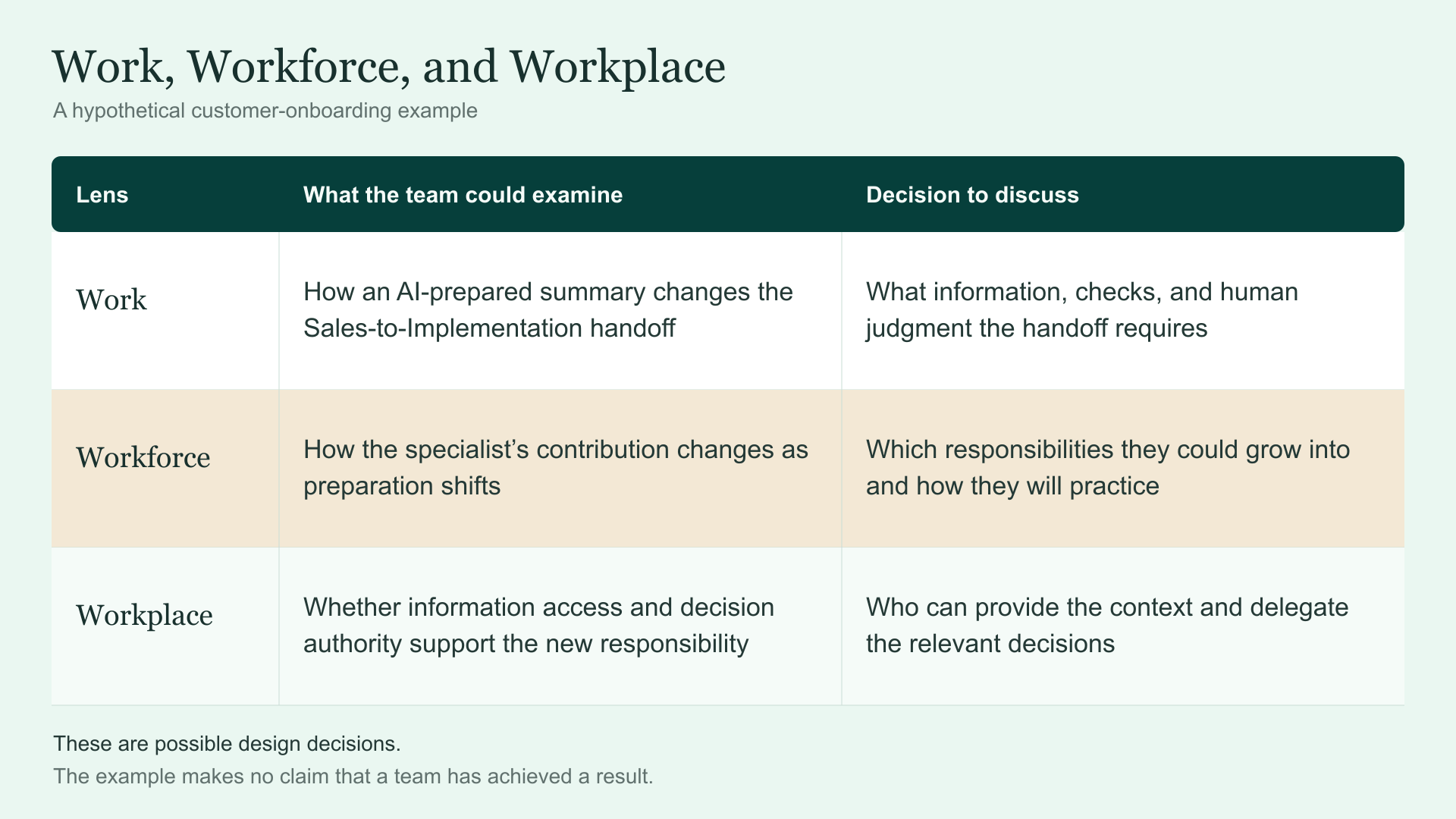
Looking across the lenses may also reveal uneven progress: the tasks have changed, while role expectations remain unresolved; or employees have developed the capability to make a decision, while the systems and approval paths still limit what they can do.
Describing that difference gives leaders a clearer account of where the change is happening and what deserves attention next.
How these moving pieces develop over time
The 3Ws can also help you discuss how the organization is developing. You might begin with scattered AI activity, establish a shared business direction, involve employees in designing new work, and then examine how those designs hold up in everyday practice.
Over time, the question becomes whether internal teams can lead further redesign and carry what they have learned into other work.
The important relationship to examine is how the Ws develop together. A team may be using a redesigned workflow while employees are still working out their contribution and leaders are still adjusting the conditions around them. Their next decision would reflect that situation, rather than an assumption that the whole organization has reached the same point.
A conversation to try with your leadership team
To make the model useful in your organization, you could bring it to a business problem that matters across teams, such as a customer handoff, an escalation, or a decision that keeps returning for clarification.
A work sample gives the discussion a common reference point, while the people who do the work can explain details that a process owner or manager may see differently.
Including relevant process and systems owners gives you a route from understanding the problem to addressing the conditions around it. For each W, the group could record:
What has changed, supported by a specific example.
What remains unresolved, including the employee’s experience.
Which decision needs attention and who can help make it.
The 3W discussion worksheet below provides a place to capture those answers. My preference is to leave with one decision that connects the business problem to people’s ability to contribute, whether that means revising the handoff, clarifying a responsibility, or providing access to the context a person needs. The group can then choose what evidence to examine when it revisits the decision.
Subscribe to access worksheet.
You would have a more specific answer the next time someone asks what AI is changing: this is how the work is being redesigned, this is what people are being asked to contribute, and these are the conditions the organization needs to address.
Where does your organization need that explanation most?
If you’re helping people use AI and need a clearer account of what the work is becoming, subscribe to Work Redesigned for practical ways to connect business decisions, employee contribution, and the conditions around the work.