

Somebody says “AI-enabled” in a leadership meeting and everybody nods.
Then somebody asks what it would take to get there, and the room produces a roadmap, a budget, a vendor shortlist, and a slide with four arrows on it. What the room does not produce is a definition. Nobody can say what would have to be true for the answer to be yes, which means nobody can say what would have to change, which means the budget is being pointed at a word.

(You have sat in this meeting. Possibly this quarter.)
Dabbling is easy to recognize. Everybody in your company could describe it accurately in one sentence. Enabled is a state, and states cannot be funded or verified unless somebody defines the edges. So here are the edges.
Everybody publishes a framework, and that is fine
Before the list, the concession, because you have seen this before.
A named set of conditions is a commodity format. McKinsey publishes six shifts. Accenture publishes five success factors. Reuters publishes five dimensions. KPMG publishes six maturity levels. If you work in a company of any size, at least two of those have crossed your desk in the last eighteen months, probably attached to a proposal. I am not going to stand here and tell you nobody else has a framework. Everybody has a framework.
What is different is the shape.
Every one of those models is a ladder. You are at level two, here is level three, here is what it costs to climb. A ladder is a comfortable instrument because it always returns good news: you are somewhere on it, you can always move up one, and nobody has to say anything failed.
This is not a ladder. It is six conditions that have to hold at the same time, and failing any one of them breaks the system regardless of how mature the company looks everywhere else. A ladder gives you a score. A conditions model gives you a named failed condition with an owner attached, and only one of those can be taken into a leadership meeting on Monday.
The order below is fixed and it is not a ranking. I am going to write one piece about each of them over the next eight weeks, and that order is a reading order rather than a sequence you install in. You do not finish condition one and move to condition two. You find the one that is missing.
The six conditions of an AI-enabled company
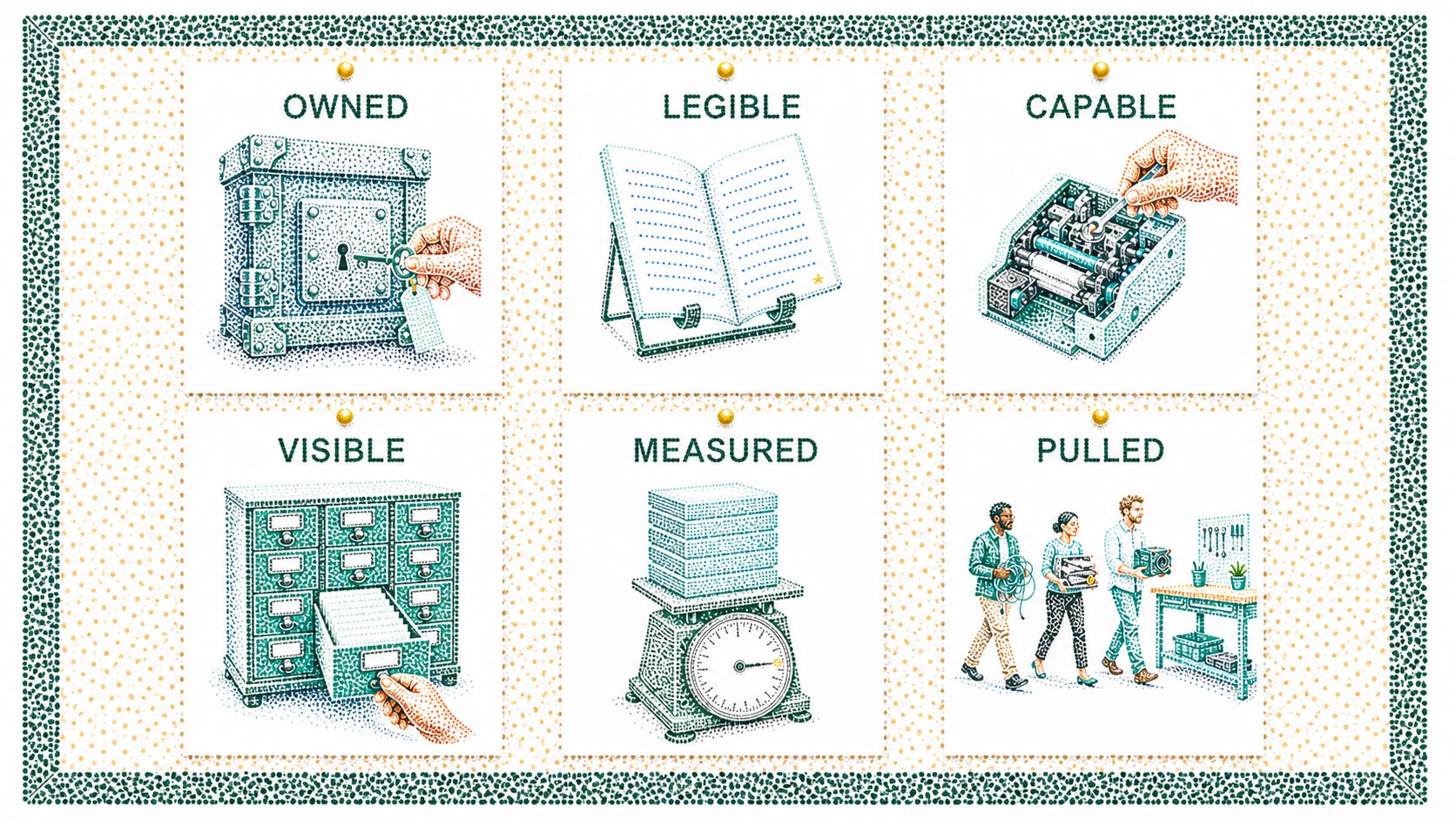
1. Owned. Every function has a name attached to the outcome, and each leader knows which part they hold. The question it answers: who holds this outcome?
2. Legible. The work is documented so a person or an agent can execute it without relying on unwritten background knowledge. Can a person or an agent execute the work as documented?
3. Capable. People can build and maintain useful automations. Managers can evaluate the output and the way the work was produced. Can people build and maintain automations, and can managers judge the output?
4. Visible. Every build is registered, costed, assigned an owner, and maintained. Duplication and orphaned workflows can be seen before they become expensive. What is built, what does it cost, and who maintains it?
5. Measured. Capability, behavior, and performance tracked on a rhythm the company can run itself. Is the company getting better, on a rhythm it runs itself?
6. Pulled. People bring their own problems without being asked. Do employees bring the next opportunity forward themselves?
Six conditions, six different questions, and each one is being asked out loud right now by a different person in your building. Your CFO is asking four and five. Your senior technical person is asking two and four. Your People leader is asking one. Your CEO is asking six and does not have the words for it yet.
What dabbling actually is
Dabbling is the inverse of all six, and written out it is unmistakable.
Nobody owns it. The work lives in people’s heads. They can prompt but cannot build. Nothing is registered. Nothing is measured. And everything has to be pushed.
Read that again with your own company in mind and notice that most of it is probably true, and that the company is not doing badly by the standards of the market. Seven percent of companies have fully scaled AI (McKinsey State of AI 2025, n=1,993). Twenty-five percent have moved 40% or more of their pilots into production (Deloitte, n=3,235). Among companies at $100M to $1B in revenue, 14% have a formal AI strategy implemented in operations, against 30% at $1.1B to $5B (Grant Thornton 2026 AI Impact Survey, n=950). The mid-market is not behind because it is careless. It is behind because nobody handed it a method.
I spent this summer talking with People and HR leaders at SaaS companies between 200 and 2,000 employees. Every one of them had bought the capability. Not one could tell me whether it was changing anything. Two of the eight were paying for AI that was switched off, and nobody in either company had noticed.
Here is what I think is actually happening in those rooms:
We bought the licenses over a year ago. I cannot ask what changed without admitting I do not know. If I say we are behind, it becomes my program to fix. If I say we are fine, somebody will eventually ask me to prove it.
Nobody says any of that out loud. So the meeting produces another roadmap.
The one question that tells you where you are
Each of these six conditions is a thing you can walk into a company and ask to see.
Owned is a name. Legible is a document. Capable is a skill. Visible is a registry. Measured is a rhythm. Pulled is an intake path.
Which gives you the question, and you can ask it on Tuesday:
How many of those six could somebody hand you this week?
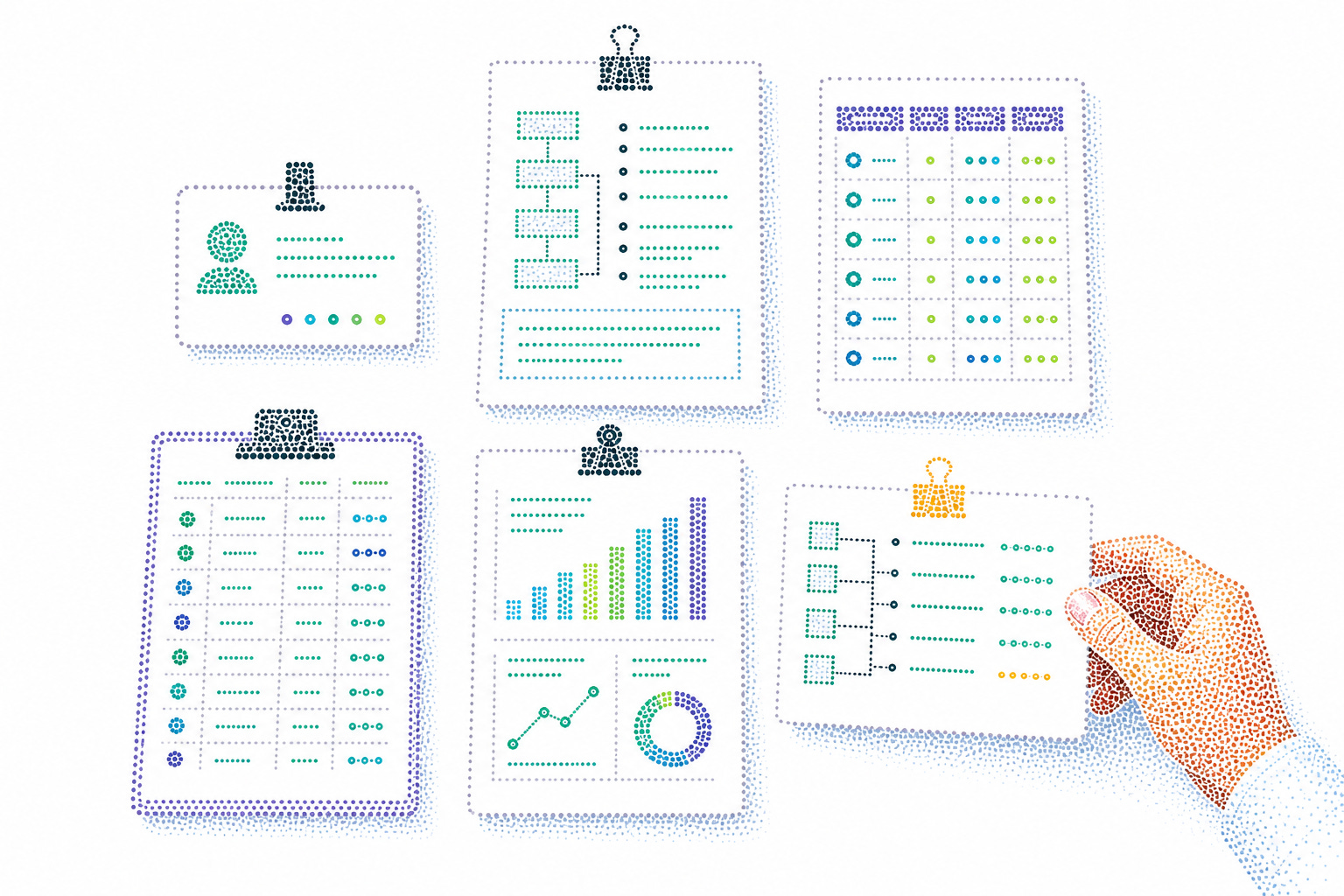
Not describe. Hand you. A name is a person, not a committee. A document is a file an agent could execute from. A registry is a list with costs and owners against it. A rhythm is a report that got produced last month because it was scheduled, rather than because somebody asked for it. An intake path is a route from “this step eats my Thursday afternoon” to something built, with a maximum elapsed time on it.
If the honest answer is one or two, you are not behind. You are dabbling, which is where almost everyone is, and now at least you know which two.
The reason this test matters more than a maturity score: it cannot be passed by intention. Every company in this category can produce a strategy deck. Very few can produce the registry. The artifact test is what keeps this model from being a mood reading, and it is the test I would apply to any condition anybody proposes adding to the list, including mine.
The honest problem with the sixth one
Now the part that costs me something.
Five of these you can install. Owned, Legible, Capable, Visible, and Measured are all things a competent team can put in place on a schedule, and I will tell you roughly how long each takes.
Pulled is different. Pulled is the one that tells you whether the other five took.

A company can hold all five, with the name and the documents and the registry and the rhythm all in place, and still be pushing every single thing uphill. Every initiative starts in a leadership meeting. Attendance is mandatory. Somebody sends a monthly reminder about the licenses. The program has a champion and no gravity. That company is going to stop the quarter the budget moves, and the five conditions it holds will not save it.
So yes, the sequencing objection is real: Pulled is partly a consequence of the other five and it lags them. That is exactly why it belongs on the list rather than in the appendix. It is the condition that decides whether you bought a project or a change.
The question that gets at it is unkind and worth asking anyway. If you stopped pushing for one quarter, what would keep running?
What to do in the next 30 days
None of this requires calling anybody, including me.
Week one. Run the artifact test on your largest function. Ask for the six things. Give people a week and take whatever arrives. What arrives is your baseline, and it is more accurate than any assessment you could fill in yourself, because it measures what exists rather than what is intended.
Week two. Name the failed condition, singular. Resist the urge to declare all six broken. Pick the one that is blocking the others, attach one person’s name to it, and give that person the authority to set a standard rather than the task of writing a plan.
Week three. Find your shadow AI and read it correctly. Somebody in your company is using a tool you did not buy, for work you did not scope. The category reads that as a governance failure. Read it as demand that found no legitimate path. Those people have already told you where the next build should go, and they told you by going around you.
Week four. Ask your CFO what number would settle it. Not what metrics are available. What number, in the units the business already uses, would make them stop asking. Write it down. Whether you can answer it in twelve months is the entire game, and most companies have never written the question down.
If you got handed AI and you are the one now expected to say whether it is working, this is the place I write about how that actually gets done. One condition a week for the next eight weeks, each one written to the person in your company who cares about it most, and each one built to be forwarded to them. Subscribe at lab.workredesigned.co.
I also built the self-assessment version of the artifact test. Six conditions, a handful of questions each, and it returns a named failed condition with an owner attached rather than a score out of six. To get access, become a paid subscriber to get this and other premium resources.
Works Cited
Accenture. (2023, August 9). The Art of Ai Maturity. https://www.accenture.com/us-en/insights/artificial-intelligence/ai-maturity-and-transformation
AI capability maturity assessment. KPMG. (n.d.). https://kpmg.com/de/en/insights/digital-transformation/artificial-intelligence/ai-capability-maturity-assessment.html
Deloitte. (2026, January 21). From ambition to activation: Organizations stand at the untapped edge of AI’s potential, reveals Deloitte survey [Press release]. PR Newswire. https://www.prnewswire.com/news-releases/from-ambition-to-activation-organizations-stand-at-the-untapped-edge-of-ais-potential-reveals-deloitte-survey-302666072.html
Deloitte AI Institute. (2026). The state of AI in the enterprise (2026 ed.). Deloitte. https://www.deloitte.com/us/en/what-we-do/capabilities/applied-artificial-intelligence/content/state-of-ai-in-the-enterprise.html
Grant Thornton Advisors LLC. (2026). 2026 AI impact survey report. https://www.grantthornton.com/services/advisory-services/artificial-intelligence/2026-ai-impact-survey
Jadematusick. (2026, August 4). The five dimensions of AI impact: A reality check for law firms of all sizes AI’s impact on law firms and its 5 dimensions. Thomson Reuters Law Blog. https://legal.thomsonreuters.com/blog/the-five-dimensions-of-ai-impact-a-reality-check-for-law-firms-of-all-sizes/
McKinsey & Company. (2025, December 10). AI at work but not at scale. https://www.mckinsey.com/featured-insights/week-in-charts/ai-at-work-but-not-at-scale
Singla, A., Sukharevsky, A., Hall, B., Yee, L., & Chui, M. (2025, November 5). The state of AI in 2025: Agents, innovation, and transformation. McKinsey & Company. https://www.mckinsey.com/capabilities/quantumblack/our-insights/the-state-of-ai
Six shifts to build the agentic organization of the future | McKinsey & Company. (n.d.). https://www.mckinsey.com/capabilities/people-and-organizational-performance/our-insights/the-organization-blog/six-shifts-to-build-the-agentic-organization-of-the-future