
Imagine you run a small renovation business, and you’ve started using AI to tidy up emails and draft proposals. Because you can get a decent first draft in seconds, a task that used to eat into your day suddenly feels more manageable.
But when Thursday evening arrives, you’re still finishing estimates after dinner while a customer waits for a quote. Someone has asked whether the price includes materials, so you’re digging through messages to find out what was agreed

While the writing got faster, your evening still disappeared.
When you use AI, how do you connect what it does to something you actually want to improve?
The tool can be useful while the problem remains
There’s plenty to enjoy about experimenting, especially when you try a prompt and discover that a task you’ve been avoiding is more manageable than you thought. That learning has value.
The trouble starts when choosing tools takes over the conversation, because you can spend an afternoon comparing features without deciding which problem deserves your attention.
Before another subscription joins the family, it helps to ask what you want to be different.
Maybe customers wait too long for answers because employees are correcting information that should have been right the first time. Or perhaps the business runs fine as long as you’re available every waking minute.
Because those problems have different causes, they need different changes, and success will look different for each.
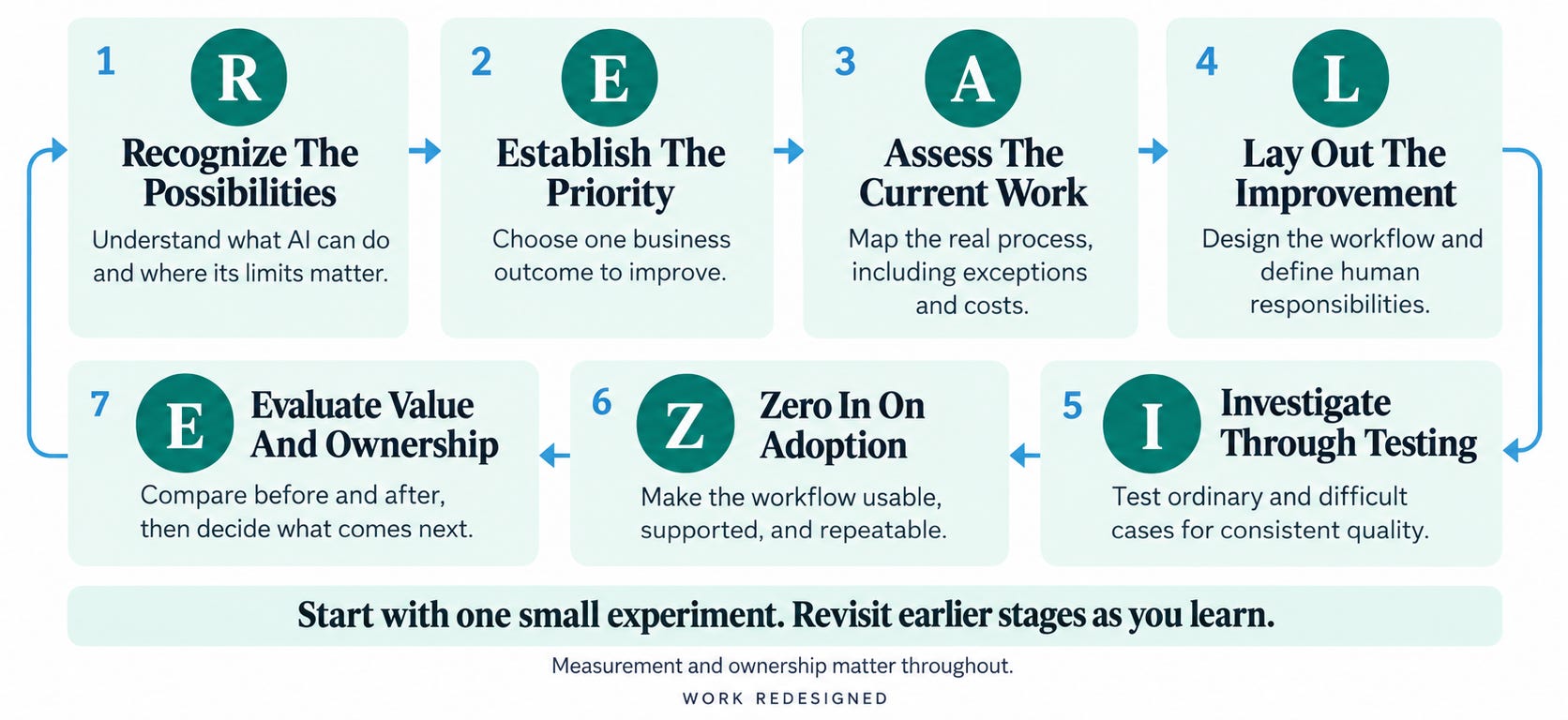
I’ve been developing REALIZE to help work through those decisions, drawing on management ideas from my work with small to mid-sized businesses, McKinsey’s AI Transformation Frameworks and adapting them into a working approach for smaller businesses and teams.
The goal is to connect a credible AI possibility to a first measurable business result while making sure people can keep the improved process running.
REALIZE gives each stage a decision to make
Here’s how I’m organizing that work to make sure your AI efforts deliver measurable business value, rather than simply creating more activity without a clear return on investment.
1. Recognize The Possibilities
Start by understanding what AI can contribute to your business today, including where its limitations could affect the work.
AI is advancing so quickly that what you thought was impossible even a few months ago may already be achievable, while tasks that once required significant technical expertise may now be much easier to accomplish.
For the home renovation business, AI might help organize a messy customer inquiry, prepare a draft using approved information, or coordinate parts of a workflow that previously required several manual steps.
A successful example helps the owner imagine what’s possible, while an example that fails reveals where human judgment, oversight, or better information is still needed.
The goal of this stage is to establish a current baseline of what AI can realistically do for your business, while also developing an informed perspective on how its capabilities may evolve over the next 6 to 12 months.
You don’t need a perfectly defined AI project to begin exploring, but you do need to understand both today’s possibilities and limitations so you can make informed decisions without building your strategy around assumptions that may soon be outdated.
2. Establish The Priority

Once you understand what AI can make possible, the next step is to narrow your focus to the specific business value you want to achieve. Rather than trying to improve everything at once, identify one meaningful outcome that would make a measurable difference to your business.
That outcome might be reducing customer onboarding time, increasing customer lifetime value, lowering operating costs, or freeing up eight hours a week so the owner can focus on growing the business. For our home renovation business, the owner might prioritize reducing the hours spent preparing proposals in the evening while maintaining accurate estimates and a positive customer experience.
The key is to be clear about what success looks like, including what you want to improve and how you’ll measure the change.
Although AI may present dozens of promising opportunities, choosing one specific business outcome gives your experiment a clear purpose, a manageable scope, and a way to determine whether the investment is actually delivering value.
3. Assess The Current Work
Before deciding what to change with AI, take a close look at how the work actually gets done today, not just how you think the process works.

Even if your current workflow seems streamlined, chances are there’s more complexity beneath the surface. Think about all the exceptions you handle, the workarounds you’ve developed, the unexpected situations that require someone to step in, and the contingencies you’ve built into the process to keep things moving. These details are easy to overlook because they’ve become such a normal part of running your business.
And don’t worry if things are messier than you expected. I see this all the time, and I’ve found that those willing to show how the work really happens, including the messy parts, often uncover the greatest opportunities for AI to deliver business value.
As you follow real examples through the workflow, document where time is spent, where people wait, what gets corrected, and how exceptions are handled. Talk to the people doing the work, including whoever receives the output next, because an improvement for one person shouldn’t simply create more work for someone else.
For our home renovation business, this might reveal that preparing proposals isn’t actually the biggest time drain. Perhaps the owner spends more time chasing missing customer details, revising estimates when project requirements change, or coordinating with subcontractors. Understanding these realities helps identify where AI could make the biggest difference while establishing a reliable baseline for measuring the results.
The goal isn’t to make your current process look good on paper. It’s to understand it well enough to make it better.
4. Lay Out The Improvement
Once you understand how work happens today, the next step is to design how it should happen with AI. There’s a lot to consider here, and this stage deserves a few articles of its own. For now, the important thing is to recognize that not every part of your workflow needs AI, and not every task should be handed over to it.
Start by reimagining the workflow rather than simply recreating your existing process with AI.
One of the biggest mistakes businesses can make is assuming that AI should follow the same steps people have always followed, just faster. Instead, ask yourself how the work might be accomplished if you were designing the process from scratch with today’s AI capabilities. Some steps may no longer be necessary, others could be combined, and entirely new approaches may become possible.
You don’t have to figure all of this out yourself, either. ChatGPT and Claude have extensive knowledge of business processes, automation approaches, and AI capabilities. Use them as brainstorming partners. Describe the business outcome you’re trying to achieve, share how the work happens today, including its exceptions and complications, and ask how the workflow could be redesigned to achieve that outcome more efficiently.
Challenge their recommendations, explore alternatives, and have them identify risks or assumptions you may have overlooked. You bring the understanding of your business, while AI can help you discover approaches you might not have considered.
As you explore these possibilities, start separating the parts of your process that are deterministic from those that are non-deterministic.
Deterministic tasks follow clear rules and produce predictable results, such as checking whether a required field is complete or calculating a price using a fixed formula.
Non-deterministic tasks involve interpretation, judgment, or decisions where there may be more than one acceptable answer, such as understanding a customer’s unusual request or drafting a personalized response.
While it’s tempting to assume AI should handle the entire redesigned workflow, a combination of traditional automation, AI, and human judgment will often produce better results. It’s also worth understanding the difference between these approaches. Traditional automations follow predefined rules, AI tasks use models to interpret or generate information, and AI agents can coordinate multiple steps, use tools, and make decisions within defined boundaries. More sophisticated doesn’t necessarily mean more valuable.
Next, look closely at the data your process depends on.
What information is needed, and at which points in the workflow?
Are you providing that information yourself, collecting it from customers, or retrieving it from another system?
How accurate, complete, and current is it?
Even a capable AI system will struggle to deliver reliable results if it’s working with incomplete or incorrect information.
Then comes an important question: How much of this process are you actually comfortable trusting AI to handle?
You don’t need to give AI control over everything to get meaningful business value. In fact, I recommend beginning with internal workflows where errors can be caught and corrected before they affect customers. Your first implementation should help you build confidence in the technology while delivering a measurable improvement, rather than introducing unnecessary risk into customer-facing work.
For our home renovation business, a redesigned workflow might begin with a clearer intake form that gathers the essential project details. A traditional automation could check whether required information is present, while AI could organize the customer’s description and prepare a proposal draft using approved information. Before anything reaches the customer, the owner would review the proposed scope, pricing, and commitments.
But what if we challenged that design further? Rather than having the owner manually collect every detail, perhaps an AI-powered intake assistant could ask customers follow-up questions, identify missing information, and organize their answers into a structured project brief. The owner might only need to review the completed brief and address unusual situations. That’s the value of reimagining the workflow instead of simply automating each existing step.
If any part of that process makes you uneasy, that’s useful information. It doesn’t mean you need to abandon the idea. It means you should establish clear boundaries and personally evaluate the AI’s output until you have enough evidence to trust it. As you see consistent results, you can decide whether to expand what the system handles independently.
Finally, compare your proposed design with simpler alternatives. Sometimes a better form, a checklist, or a few fixed rules will solve the problem without AI at all. The objective isn’t to fit as much AI into your business as possible. It’s to design a workflow that delivers the business outcome you’re after, with the right balance of efficiency, reliability, cost, and human oversight.
5. Investigate Through Testing

Once you have a working prototype of your redesigned workflow, the next step is to evaluate whether it consistently delivers the results you expect. Getting AI to complete a task successfully once is encouraging, but that doesn’t mean you have a reliable process.
Think of AI as an employee. Well, sort of. Give it the same task several times, and it might approach things differently each time. It could overlook instructions, forget details, introduce information you didn’t request, or find creative solutions to unexpected problems. Some variation is useful, but you need confidence that the results consistently meet your business standards.
This is where quality checks, often called evaluations or evals, come in. Test your workflow with different examples, including ones that contain missing information, unusual requests, or conflicting details. For our home renovation business, what happens when a customer leaves out important measurements, requests a service you don’t offer, or provides information that could lead to an incorrect estimate?
Start by reviewing the results yourself, checking both accuracy and whether the output meets your expectations. Human review is valuable, but it becomes difficult to scale. As your workflow matures, consider adding AI-based reviewers that automatically evaluate outputs against defined criteria. For tasks with clear, deterministic rules, such as verifying that required fields are present or calculations fall within established limits, simple coded checks can provide more predictable validation.
The goal is to build quality checks directly into your workflow, rather than relying on someone to catch mistakes afterward. Remember to measure the time spent reviewing and correcting AI’s work, too. If generating a proposal becomes faster but fixing its mistakes takes longer, you haven’t achieved the business value you’re looking for.
A successful prototype shows what’s possible. Consistent, measurable performance tells you whether it’s ready for your business.
6. Zero In On Adoption
Once you’re satisfied that your AI workflow consistently produces reliable results, the next step is to make it a standard part of how your business operates.
A successful prototype is one thing, but getting employees to use it effectively during their normal working day is another.
Start by defining how the workflow will operate.
How often should it run?
What does the employee need to do for it to succeed?
What are they responsible for reviewing or approving, and what happens when something goes wrong?
Someone should clearly own the process, including handling exceptions, fixing problems, and knowing when to fall back on the original way of doing things.
Employee adoption is just as important as the technology itself. Depending on how much the workflow changes someone’s responsibilities, you may need to provide training, opportunities to practice, and clear instructions for handling unusual situations.
Don’t assume that because a process is easier or faster, employees will automatically know how to use it or feel comfortable trusting it.
For our home renovation business, the owner might hand off proposal preparation to an office manager who now reviews AI-generated drafts instead of creating them from scratch. That employee needs to understand what the AI handles, how to verify estimates, when to intervene, and who to contact if the system stops working.
After the workflow has been running in your business for at least a few weeks, sit down with the person responsible for it and review what’s actually happening.
Are employees using it as intended? Where are they encountering friction, creating workarounds, or spending more time than expected? Look for opportunities to simplify the process, improve reliability, and reduce unnecessary oversight.
The goal isn’t simply to introduce a new AI workflow. It’s to make the improvement a sustainable part of your business, with clear ownership, confident employees, and a process that continues to get better over time.
7. Evaluate Value
Now it’s time to measure whether your redesigned workflow is delivering the business value you set out to achieve. Start by comparing how the work was done before AI with how it operates today, looking at the time required to complete each task, total employee hours involved, operating costs, and how much work the business could handle with its previous process.
Then measure those same factors with your new AI-powered workflow. How much time are you saving? Has the cost of completing the work decreased, including the cost of AI tools and human oversight? Can your business now handle more customers or complete more work without adding employees?
For our home renovation business, perhaps preparing proposals previously required 10 hours of the owner’s time each week, but the new workflow has reduced that to two hours. That’s eight hours the owner can now spend meeting potential customers, managing projects, or simply getting their evenings back.
Focus first on the measurable business outcome you identified earlier in the framework. Did you achieve what you set out to accomplish? Once you’ve answered that question, look for additional benefits you may not have anticipated, such as faster customer responses, fewer errors, increased capacity, or improved employee satisfaction.
Finally, use what you’ve learned to decide what happens next. You might continue with the workflow, make further improvements, expand it to other parts of the business, or even stop using it if the results don’t justify the investment. All are valid decisions when they’re supported by evidence.
Remember that these stages aren’t always linear. As you measure results and learn more about how AI performs in your business, you may discover opportunities to revisit earlier decisions. The goal isn’t simply to prove that AI works. It’s to prove that it’s making your business better.
How to Use REALIZE in One Small Experiment
Seven stages can sound like the beginning of a very large change.
For a small, low-risk workflow, the essential decisions may fit in one shared document, provided the effort still reflects the consequences, dependencies, and complexity of the work.
A personal drafting experiment needs less structure than a process making customer commitments, while a consequential decision may require specialist help even in a tiny company.
A small experiment can still ask useful questions.
Choose one part of your work and write down what you want to improve, what currently happens, and what would count as evidence of a better result. Once you’ve done that, name the uncertainty you need to investigate first.
You can start there.
Where have you tried AI in your work, and what were you hoping would improve? Leave a comment or reply and tell me where you got stuck.
If you’re trying AI but struggling to connect it to a useful change in the work, subscribe for practical ways to choose and test your next step at