

The quarterly business review had a slide that said adoption was ahead of schedule.
Eighty-three percent licensed. Seventy-one percent completed the training. The line chart pointed up and to the right. The steering committee nodded.
Nobody asked what was underneath that number.
Here’s what was underneath it: the seventy-one percent who completed training were not a random sample of the workforce. They were, in ways that would not surprise anyone who has worked in I&D for more than six months, the employees who already felt the most comfortable being visibly bad at something new.
The other twenty-nine percent completed the onboarding email. They did not open the tool again.
And of the seventy-one percent who “adopted”? About forty of them are doing something genuinely new with it. The rest are using it to reformat bullet points.

This is what uneven AI adoption looks like from the outside: a dashboard that says it’s working.
This is what it looks like from the inside: a productivity gain that belongs to the already-confident, while the employees who needed the rollout to reach them are exactly where they were before the licenses were purchased.
Sound familiar? Good. Then this is for you.
Why adoption splits along the lines belonging already breaks
The most important finding in the behavioral science of AI adoption is this: the variable that predicts whether someone will persist through early awkwardness is not technical ability. Not interest in technology. Not job function.
It is the cost of looking incompetent.
For employees who have built deep credibility, long tenure, visible sponsorship inside the organization — looking uncertain with a new tool is a recoverable event. They try something in front of a peer, it doesn’t work, they shrug and try again. The social cost is manageable. So they experiment. So they find the use cases. So they become the internal champions who get featured at the next all-hands.
For employees who are still building credibility — who are already managing the cognitive load of navigating environments not fully built for them, who calculate more carefully how each visible moment lands — looking incompetent with the new tool is not a recoverable event. It’s evidence. So they don’t experiment publicly. They wait until they can do it privately. Private practice requires time they don’t have and a scaffolded space to fail that the rollout didn’t provide. So they close the tab.
This is completely rational behavior under the actual conditions these employees work in.
The adoption gap maps, with uncomfortable precision, onto familiar coordinates: confidence, tenure, first language, proximity to leadership, and whether the employee has ever felt like the room was built for them. The efficiency gap and the inclusion gap widen in the same rollout. Just never in the same sentence.
And here is the thing I want to say as clearly as possible: this is a design problem. Not a people problem. Not a capability problem. A design problem. Which means it has a design solution.
The Want, Ease, Cue Behavioral Lens
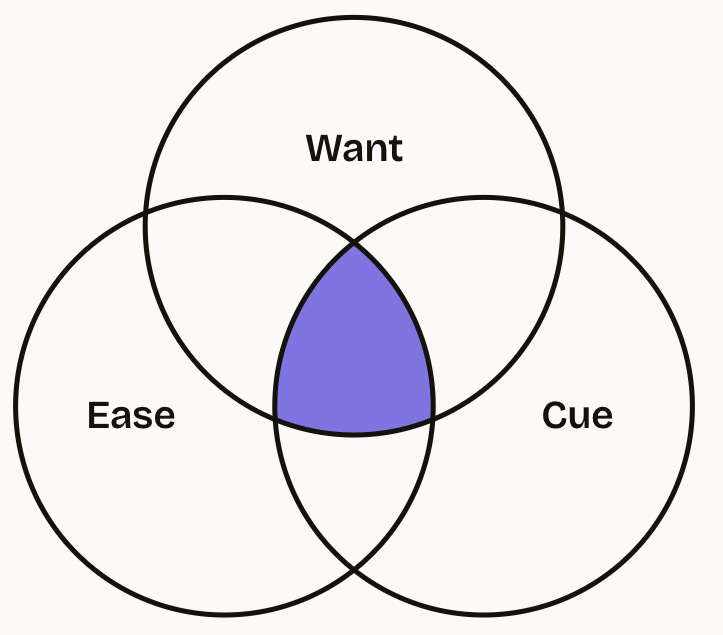
Behavioral science gives us a clean diagnostic here. Call it the Want, Ease, Cue framework. For a behavior to take root, three things need to be true.
Want: The person needs to believe this tool will help them, specifically, in their actual work. Not “help people generally.” Help me, on my tasks, in my role, this week. Generic ROI pitches don’t create Want. They create an abstract awareness that AI is probably useful somewhere. Awareness is not the same as motivation.
Ease: The first attempt needs to be easy enough to produce a result that feels good. Not impressive. Just good enough to keep trying. This means low stakes, a place to practice, and enough scaffolding that the first use doesn’t require performing competence in front of people you’re trying to impress.
Cue: Something in the person’s actual environment needs to remind them to use it, at the right moment. Not a launch email. Not a Slack announcement sent to all eight hundred employees. A specific, recurring signal built into the normal rhythm of their actual work.
Most rollouts address these three things once each. The kick-off call addresses Want. The ninety-minute training addresses Ease. The monthly newsletter addresses Cue.
Then the rollout declares it’s done and moves to measurement.
Here’s what actually happened: Want worked for people who were already motivated. Ease worked for people who were already comfortable learning publicly. Cue worked for people who were already paying attention to company communications.
For the employees who needed more from each of these, one pass through the funnel was not enough.
The employees who were already confident went home and experimented on their own until they got it. The rollout just gave them a timeline. The employees who needed the rollout to meet them where they were — they needed the rollout to actually do that. It didn’t. And now they’re in the twenty-nine percent.
What to look for in the equity audit
Before a rollout hardens into permanent adoption patterns — typically somewhere between months three and six — there’s a real window to change it. After month six, the patterns tend to calcify. Here is what to audit and where to look.
Adoption data, cut by demographic proxies. Not by stated identity — that creates compliance issues and asks for data many organizations can’t legally collect or use. By tenure band, by department, by job level, by location. These are imperfect proxies. But they surface the shape of the gap. If adoption is significantly higher among employees with ten-plus years of tenure, or among senior individual contributors, or in certain locations, that pattern is not random. It’s telling you something.
The training design, specifically the performance requirement. Does the onboarding require employees to practice in front of each other? Share outputs for group feedback? Does the group format put some employees in a position where being wrong has a different cost than it does for their peers? High-performance-risk training disproportionately deters the employees who most need a safe place to try. It’s the design equivalent of teaching swimming by requiring everyone to demonstrate their stroke in front of the class before they’ve had a chance to practice.
The cue architecture. What actually tells an employee to use the tool on a given Tuesday afternoon? If the honest answer is “their own motivation” or “the all-hands from last month,” the cue architecture is relying on intrinsic drive. Intrinsic drive is a resource distributed unevenly. Rollouts that depend on it reach people who were already motivated — which is a fine thing to do, but it’s not a rollout. It’s a self-selection event.
The manager layer. What are managers doing with AI? What are they modeling publicly? What are they explicitly making space for? Employees take behavioral cues from the person whose opinion of their work matters most. A manager who has not visibly adopted the tool sends a clear signal: this is optional. That signal lands differently on different employees. For the employee already calculating every visible risk, “optional” reads as “not worth the exposure.”
The moves that close the gap
Let me be very clear about something before we get into specifics: these are not equity initiatives bolted onto an efficiency project. They are better rollout design. Every employee benefits. The employees who most needed the rollout to reach them experience the largest difference.
Segment the Want conversation. One kick-off deck does not address Want for every job function, every seniority level, and every person’s actual daily frustrations. Build use-case conversations by team and by role, facilitated by a manager or peer, that help each person connect the tool to the specific thing they most dread doing. Not “here’s what AI can do.” Here’s how this might help you stop doing the thing you hate most. That conversation takes twenty minutes. It creates genuine motivation in a way that forty-five minutes of ROI data does not.
Design practice that doesn’t require an audience. Small cohorts of three people, matched for role and seniority, with a structured first-use task and a single clear output. The goal is not for anyone to look impressive. The goal is for everyone to get one win before they have to use the tool in front of someone who evaluates them. One win is enough to create the second attempt. The second attempt is what creates the habit.
Build cues into existing workflows, not alongside them. The question is not “what new reminder can we create?” It’s “which meeting that already happens could include one standing agenda item? Which checklist that already exists could have one step that references AI?” The best cue is one the employee doesn’t have to remember. It appears because the process they already follow makes it appear.
Make manager adoption visible and specific. Not a mandate. A norm. Which manager is going to share, at the next team standup, one thing they tried with AI this week — including what fell apart? That modeling matters more than any amount of training content. The employee who is calculating the cost of looking wrong needs to see their manager willing to look wrong and be fine.
The harder framing
The efficiency case for AI is real. The time-to-value gains are measurable. The business rationale holds.
But a rollout that reaches only the already-confident doesn’t deliver those gains to everyone. It delivers them to a segment of your workforce. Six months later, the employees who were already winning at work are further ahead. The employees who were navigating more are further behind. Quietly. Inside a project that got filed under productivity.
*We spent six months on this.*
*We have the dashboard.*
*Nobody’s going to say the rollout created a two-tier workforce.*
*Nobody’s going to say it out loud.*
I know you’re sitting with this. And the answer isn’t to slow the rollout or turn the efficiency initiative into a committee that deliberates for another two quarters. It’s to design it so it actually reaches everyone. The tools exist. The framework is specific. The window is still open.
**The productivity gap and the inclusion gap widen in the same rollout. You can close both at once — but only if you design for everyone from the start.**
That’s the work. It’s good work. And you can absolutely do it.
This is the space for practitioners doing this work in real time: auditing rollouts for equity risk, building the behavioral architecture that makes AI reach everyone, sharing what’s actually working in the field. Come subscribe at https://lab.workredesigned.co. We’d love to have you.