

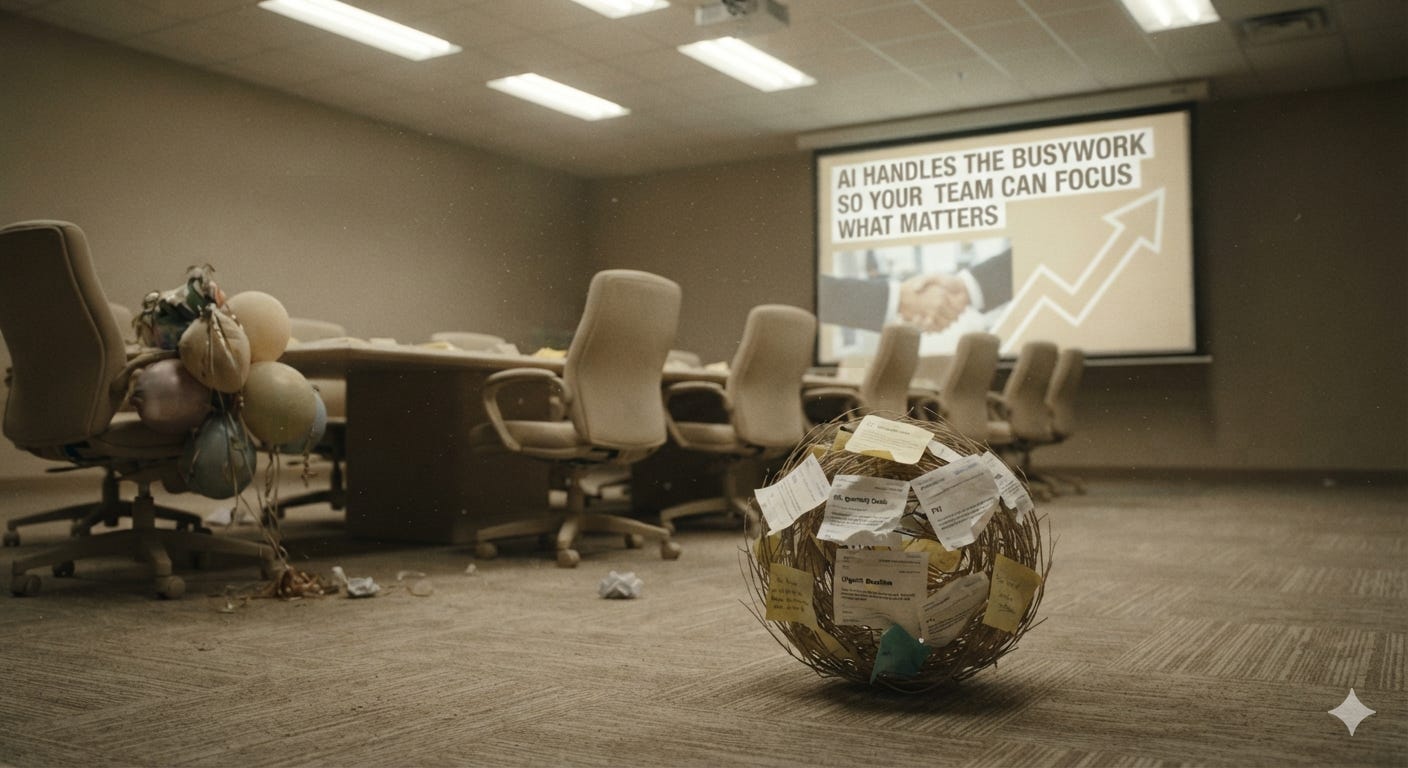
Okay, let’s talk about that slide. You know the one. It shows up in almost every AI rollout deck and it says some version of the same shiny promise:
*AI handles the busywork so your team can focus on the work that matters.*
Somebody made that slide with real conviction. Somebody presented it to a leadership team that nodded along. And then everybody went back to their desks, and the slide quietly became one of the great unkept promises of modern work.
I want to walk you through exactly how that promise breaks, because BCG just published the receipts. And then, because I refuse to leave you in the problem, I want to show you the people who kept the promise and exactly what they did differently.
Deep breath. Here we go.
The good news, then the plot twist
Their 2026 AI at Work report surveyed close to 12,000 workers across 14 markets. Here is the finding that stopped me in my tracks, in the best way.
Forty-two percent of regular AI users on the front line are saving at least a full workday every single week. That is not a vendor projection. That is real people reporting real, recovered time. Eight hours. Gone from the busywork column.
Take the win for a second. The time savings are real. The tool works.
Sixty-six percent of those same people get little or no guidance on what to do with the time they just saved. And more than half never redirect it into anything strategic. BCG’s phrase for what happens next is almost poetic for a consulting firm. The time saved “leaks out of the organization.”
It leaks. You paid for the tool, your team did the hard work of learning it, the hours came back exactly as promised, and then they slipped right out through a crack nobody thought to seal.
If you have felt this on your own team, it’s a real thing and you aren’t crazy.
Where the hours actually go
Let me make this real, because “time leaks out” sounds abstract until you have watched it happen at your own desk.
The hours do not float off into nothing. They get refilled.
The second someone finishes a task in twenty minutes instead of two hours, the system notices that lovely open space and stuffs it.
More tickets. More drafts. More requests that used to be “we do not have capacity for that” and are suddenly, magically, things you have capacity for. The work expands to swallow the time. It is one of the oldest laws in operations, and AI did not repeal it. AI just made it faster.
And here is the second leak, the one that genuinely surprised me. Forty-seven percent of workers now spend more time managing and directing AI than doing the actual work. We bought tools to take work off our people, and half of those people now spend the day supervising the tool instead.
You have seen this movie. Someone asks the AI to draft the thing. It comes back almost right. So they re-prompt. Still almost. They tweak the prompt again, get closer, then spend ten minutes fixing the parts that are subtly off, and somewhere in there they think the words every rollout dreads: *it would have been faster to just do it myself.*
That is not your person failing. It is not even the tool failing. The tool did exactly what tools do. What broke was the design around it. And design, my friend, is something we can change.
The thing nobody redesigned
Here is the heart of it, and I am going to say it plainly, because that is what this newsletter is for.
Your AI did not save your team time. It offered to. Whether they got to keep it came down to one question almost nobody asked: did you redesign the work, or did you just bolt a faster engine onto the same old process?
Most companies did the second thing, and honestly, that is completely understandable. They took a workflow that was built, step by step, for humans doing every step, and they dropped an AI into the middle of it. The workflow kept its old shape. The handoffs stayed. The approvals, the formats, the who-checks-whose-work, all of it sat exactly where it was the day before the tool arrived. So the AI could only speed up little steps while a human still had to escort it through every junction, catch its mistakes, and reshape its output to fit a process designed for a different kind of worker.
You did not get a redesigned workflow. You got the old workflow with a very fast, slightly unpredictable new teammate wedged into the middle of it, and that teammate needs a lot of supervision.
That is why the time leaks. There was no new container built to hold it. So let’s build the container.
The cohort that kept the hours (this is the fun part)
Here is where I get excited, because BCG did not just find the problem. They found the people who solved it.
They compared two groups.
One bought AI and deployed it: licenses, a launch, some training, done.
The other bought AI and redesigned the work around it. They took whole workflows apart and rebuilt them for a world where the AI does certain steps and the human does the steps that actually need a human heart and brain.
The redesign group was 24 points more likely to see real business improvement. They were 22 points more likely to actually save a full day a week, the exact time savings everyone else was promised and lost. And they were 20 points more likely to report being happier at work, because their people were not drowning in a more demanding version of the same job.
Same tools. Same models. Same price tag. The entire difference was what they did to the work.
BCG put a number on it that I cannot stop thinking about. A better tool lifts AI’s impact by roughly 5 points.
A clear strategy and redesign lifts it by 25. So picture it: an entire industry sprinting around shopping for a better model, a five-point lever, while the twenty-five-point lever sits right there, patient and unglamorous and totally available to anyone willing to pick it up.
You are allowed to be the one who picks it up.
What this actually means on Monday at 1:36PM
Here is the relief. You do not need a bigger budget. You do not need a better model. You do not need to send anyone to another prompting webinar, and honestly I would gently retire those, because teaching people to prompt a broken workflow faster just gets you to the broken outcome sooner.
You need to pick one workflow. Just one. The one where your team feels busiest and least sure why. And you redraw it from scratch with one question in front of you: if the AI is genuinely great at certain steps, what should this whole process look like now? Not “where can I wedge AI into the process I already have.” Start fresh.
That is the move. It is not flashy. It will not get applause at the all-hands. But it is the entire difference between the 42 percent who keep a real workday and the two-thirds who watch it leak away.
The honeymoon ends on schedule either way. BCG found the joy of AI fades within about a year unless there is real direction behind it. The teams that reshaped the work kept the joy and the hours. The teams that just deployed kept the license and the exhaustion. You get to choose which team you lead.