


The part of the Purple mattress ad campaign I remember best involves a car that smelled like rotten eggs.
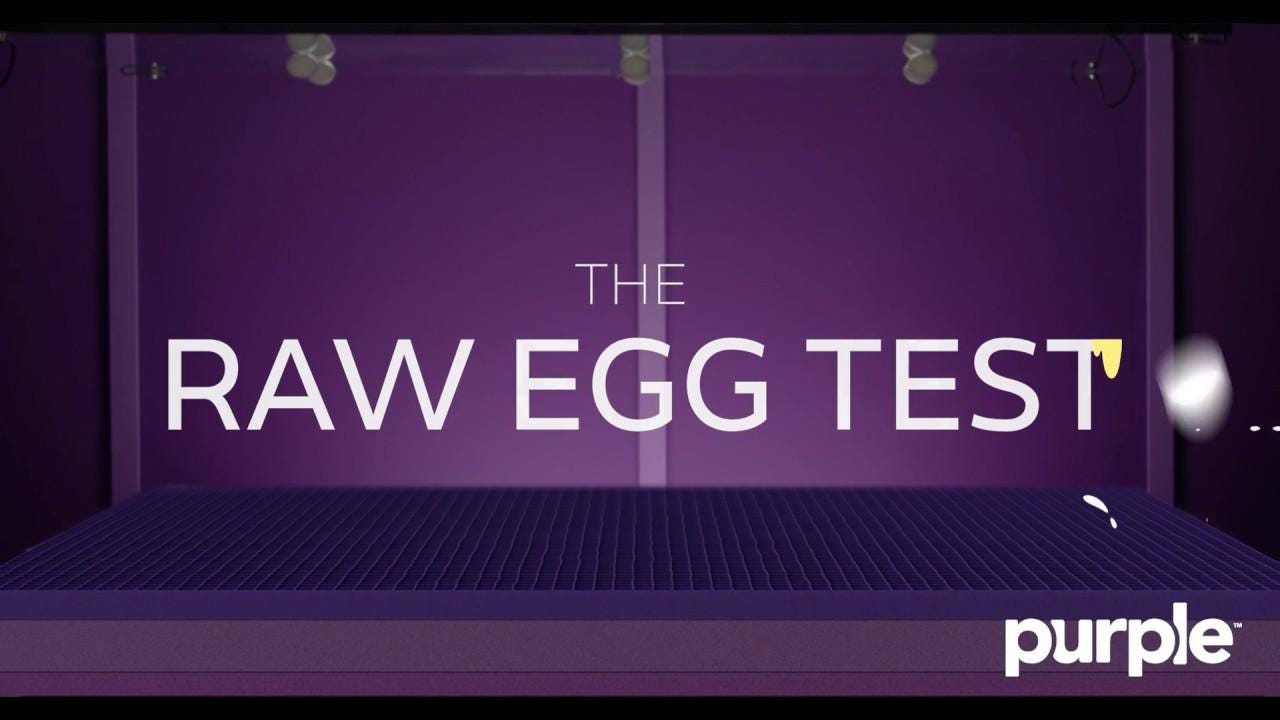
YouTube version of the ad. (I can’t find the FB one, but it is the same idea.)
Here’s the story of one of my favorite working experiences. There’s a point to why I am sharing this. :)
I was working at Facebook and creating training for Harvard MBA students on how to build an advertising strategy based on innovative brands like Purple. I interviewed people on the Purple leadership and marketing teams to understand how they’d arrived at one of their stranger ideas. In the ad, raw eggs survived a drop onto a mattress. If you were trying to sell a mattress over the internet, that gave people something they could see for themselves.
As the Purple team told it, people in their focus groups said they wouldn’t buy a mattress online because they wanted to feel it first. Then someone on the team mentioned a trip to the grocery store. A few eggs had broken on the drive home, the liquid had soaked into the carpet, and now a week later, the car smelled. In the version I heard, that complaint at a team meeting helped spark the idea for the egg demonstration.
Harvard Business School already had a case study on Purple. However, what I loved about my work on this project was hearing how the people involved had thought through the problem. The messy, imperfect part of the work.
When I led a guest session for the students, I wanted them to see how a creative idea can come from something ordinary. I also wanted them to think about what to do with the focus-group feedback. People were telling Purple what they needed to feel comfortable buying. The team still had room to figure out how to give them some of that confidence online.
Which part would you want to do again?
I enjoyed talking to the Purple team. But when I look back on the whole project, the part I’d most like to do again is figuring out how to teach something nuanced through a real example. I like putting a method to the madness.

In this case, that meant working out what the students could learn from the story once they got past the eggs. I wanted them to see the distance between what people said they’d do and the question a marketer could still ask. What could you show a customer who wants to feel a mattress before buying it?
This gives me something specific to teach an AI assistant about how I work. When I share this story with my AI assistant, I want help finding where the people involved had a choice, what they knew at the time, and what was still up in the air. I want to decide which part is worth teaching and how to ask about it in a room.
What AI learns from your stories
While I could tell my AI assistant that I like writing practical content, it would still have to guess what makes a piece practical to me. When I share the Purple story, it has something specific to work with. It can see why I paid attention to how the broken eggs from the teammate’s car story influenced the Purple ad, which then influenced what I taught to the HBS students. And more importantly, it understands that I love to take seemingly unrelated things, turn it into a story that becomes useful for teaching something else. That’s my approach, and now AI knows. “Show, don’t tell” as I used to tell my students in English class.
This is how it works in my current AI.

Say I ask AI to help me create a slidedeck for a client on improving the customer experience for their company. With this story in mind, it could suggest starting with a metaphorical story asking attendees what they felt like when I told them that story. And that could shape the ideas I want to teach on how to improve the customer experience. From this vantage point, AI can look for the same kind of moment and help me turn it into a question a attendees can think through related to their work. And I still am in control of which part is worth sharing.
The main idea here is that your favorite stories can teach your AI what you pay attention to and why it matters to you. That gives it a better sense of how you see the work when it helps you choose an angle and create something new.
Try it with three stories from your own work
Write the stories yourself
Pick three specific moments when you enjoyed the work. A small moment counts, like the ten minutes you spent figuring out how to explain something to a colleague. Write a short story about each in your own words before you open AI. Use the same three questions each time.
What was happening, and what was your part in it?
What did you notice, do, or decide, and what happened next?
Which part did you enjoy most, and what made it satisfying for you?
Ask AI what each story tells it about you
Paste all three stories into your AI assistant. Give it this instruction.
Read these three stories. For each one, point to a detail that shows something about how I like to work or what I pay attention to. Tell me how that might change the help you give me when I’m creating content. Then tell me what repeats across the stories and what may have been specific to one situation. Mark anything you’re guessing about.
Read its takeaways with the original stories beside you. If it says you love leading meetings and what you really loved was helping two people understand each other, tell it that. Keep the takeaways that match your experience, and put them next to the stories in your own words.
Save what you want it to carry forward
Ask your assistant to save the stories and the takeaways you’ve approved in its main memory. Keep a copy of the original stories and takeaways in one document too. Memory can summarize or leave out details, and you may want the original wording when you work on a new piece.
Remember these three work stories and the takeaways I’ve confirmed. When you help me write content, use them to understand how I see the work. Let that shape the angles, examples, and questions you suggest. Use the stories as background unless I ask you to tell one, and ask me if a detail is missing.
The next time you draft a Note, an article, or a script, ask your assistant which story shaped its suggestion and what it picked up from it. If it points to a detail you care about, you’ll have something to build on. If it takes the wrong lesson, tell it what you saw in the story and ask it to remember the correction.
If you keep rewriting AI’s first draft because it misses what matters to you, subscribe for practical ways to teach it how you work. Work Redesigned
Sources
Purple’s description of the egg demonstration and the Harvard Business School case listing. The interview and classroom details come from my recollection. Purple’s Raw Egg Test · Harvard Business School case
Stories carry what people can’t put in a list. Ask someone what they value and you get adjectives. Ask about a moment they loved and you get the thing itself.