

Okay. Real talk about this phrase.
Somebody in your company has already typed “AI-enabled” into a slide. It sailed through the review. Nobody stopped to ask what it meant, and here’s why that happened: everyone in the room had a private definition, and every single one of them was reasonable.
Your CTO heard infrastructure and access.
Your CFO heard a line item that has finally started giving something back.
You heard people using it well, safely, without you having to chase anyone about it.
Three people, three different sentences, one nod.

I find that genuinely fascinating. That phrase is the only claim in the whole deck that can’t be checked. You can’t verify it, so you can’t be wrong about it, so it can’t be funded and it can’t fail. It just sits there being pleasant.
(You’ve sat in that meeting. Possibly this quarter.)
So let’s talk about what it’s standing in for, because the thing underneath it is usually not a mistake at all.
Can we give the AI Pilots their due for a second?
The dabbling stage was the right call.
Think about where you were in 2024. Nobody could have told you which workflow to aim this at, because the technology was moving faster than anyone could point it anywhere. Letting people try things was the only sane response available, and it did work that a plan could never have done.
It found your willing people. The four or five in the building who’ll pick up something new without being asked twice. You know exactly who they are. It found the live use cases, the ones people actually cared about instead of the ones a consultant would have nominated in a workshop. And it surfaced your objectors early, which sounds like a problem and is really a gift, because most of those objections were correct.
If you ran that stage, you did a good thing, and being wrong about any of it cost you almost nothing.
Which is the part that changed.
Experiments were cheap in 2024 because nothing was sitting on top of them. Two years in, that arithmetic flips. Every quarter you spend in the experimental stage adds automations nobody wrote down, licenses nobody costed, and builds that were good enough for one team quietly getting copied into three more. Those get harder to unwind every month they run, because the next thing gets built on top of them.

There’s a point where pulling an automation out is riskier than leaving it in. After that point you’re paying to maintain something you can no longer change.
Waiting doesn’t hold the problem still. It makes the problem more expensive.
Why the question resists an honest answer
Here’s what I keep noticing about “are we AI-enabled.”
Nearly every published model in this category is built as a ladder. Levels, stages, tiers, dimensions. The big firms all have one, and so do most of the platforms. If you’ve taken three vendor calls this year you’ve met at least two, and they’re serious work by serious people. I’d be insulting you to pretend otherwise.
But a ladder answers “how far along are we,” and that question comes with a built-in escape hatch. You’re at level three. Level three feels like progress. Level three gets filed. Nothing about Monday changes.

Two numbers get my attention here. McKinsey’s Global Survey on the state of AI, 1,993 participants across 105 nations, fielded June through July 2025, found 7% of respondents saying AI had been fully scaled across their organization. Meanwhile RSM’s cybersecurity special report, 501 middle market executives, fielded in January 2026, found 44% with defined roles and responsibilities for AI decision-making, and 35% with a formal AI governance framework.
So a lot of companies have named somebody. Very few have scaled anything. That gap is basically the whole subject.
And here’s where I’d push back on my own framing
I used to talk about this as a finish line. Get one function done, then the next one. There’s something useful in that, and I’d like to correct the part that’s misleading.
AI enablement doesn’t finish. There isn’t a state where you’ve arrived and can stop paying attention. Anyone who sells you that is selling you a project when what you have is a way of operating.
What you’d actually want, if I’m being precise about it, is something that expands on its own. Where the second function starts from what function one learned rather than from zero. Where somebody in finance builds a thing and it lands in the same registry as everyone else’s, because that’s just how it’s done here. Where new people arrive and absorb the standard without you running a session about it. Where the thing keeps growing and keeps holding without needing to be rebuilt every time a tool releases a new version.
Self-sustaining is closer to it than finished. The question I’d ask isn’t which function you completed. It’s more like: **which function keeps going without you pushing it?**
The part that surprises people
Most of what makes that possible has very little to do with the technology.
I’d put it at a strong majority, and the majority is culture, people, the context your AI tools are working from, and the processes underneath both. The tools are the easiest part and the smallest part.
Culture, meaning whether somebody can say “I tried this and it was wrong” in a room without it becoming a thing. Whether a manager can admit they can’t evaluate what just crossed their desk. Whether a person who builds something useful gets asked to share it or gets quietly resented for it.
People, meaning the four or five who’ll actually carry this, and whether they’re supported or just tolerated. And the managers in the middle, who are the layer every AI program skipped and the layer that decides whether any of it lands.
Context, meaning what your AI systems know about your company before they do anything. Which brings me to the condition that has changed shape since I first wrote it down.
Legible goes much further up than people expect
Most people hear Legible and think process documentation. SOPs, the real sequence including the workaround and the shadow spreadsheet everyone pretends isn’t load-bearing, the failure path written next to the happy path.
All true, and it’s the smaller half.
The bigger half sits upstream of any process. It’s whether your company’s own foundation exists somewhere readable. What the company is for. Who it serves and who it deliberately doesn’t. What it will and won’t do. How it sounds. What it’s trying to have become true in eighteen months. Held in one place, kept current, and actually checked against rather than written once and admired.
Here’s why I’d put that inside a condition instead of leaving it in a values workshop.
The moment AI goes into real work, you’ve handed judgment to something that can’t read the room. Every output it produces gets evaluated against a standard. If that standard was never written down, it lives in the head of whoever happens to be reviewing that day. It differs between reviewers. It drifts. And nobody can point at the drift, because there was never anything to point at.
A company with an undocumented foundation doesn’t have a governance problem yet. It has one waiting, and it tends to show up on the day AI-assisted output exceeds what one careful person can read.

The test for it is unglamorous. Could somebody outside your team tell what your company is for, who it serves, and what it refuses to do, from a document, without asking a human? If that’s a no, then Legible is already struggling at the top before it gets anywhere near your processes.
Something to try, if you feel like it
This isn’t homework and I’m not going to tell you how to run your company. But if you wanted a version of the question you could actually answer, here’s the one I’d reach for.
Pick one function. The company as a whole is too big to answer for honestly, so take the single place where the most is already happening.
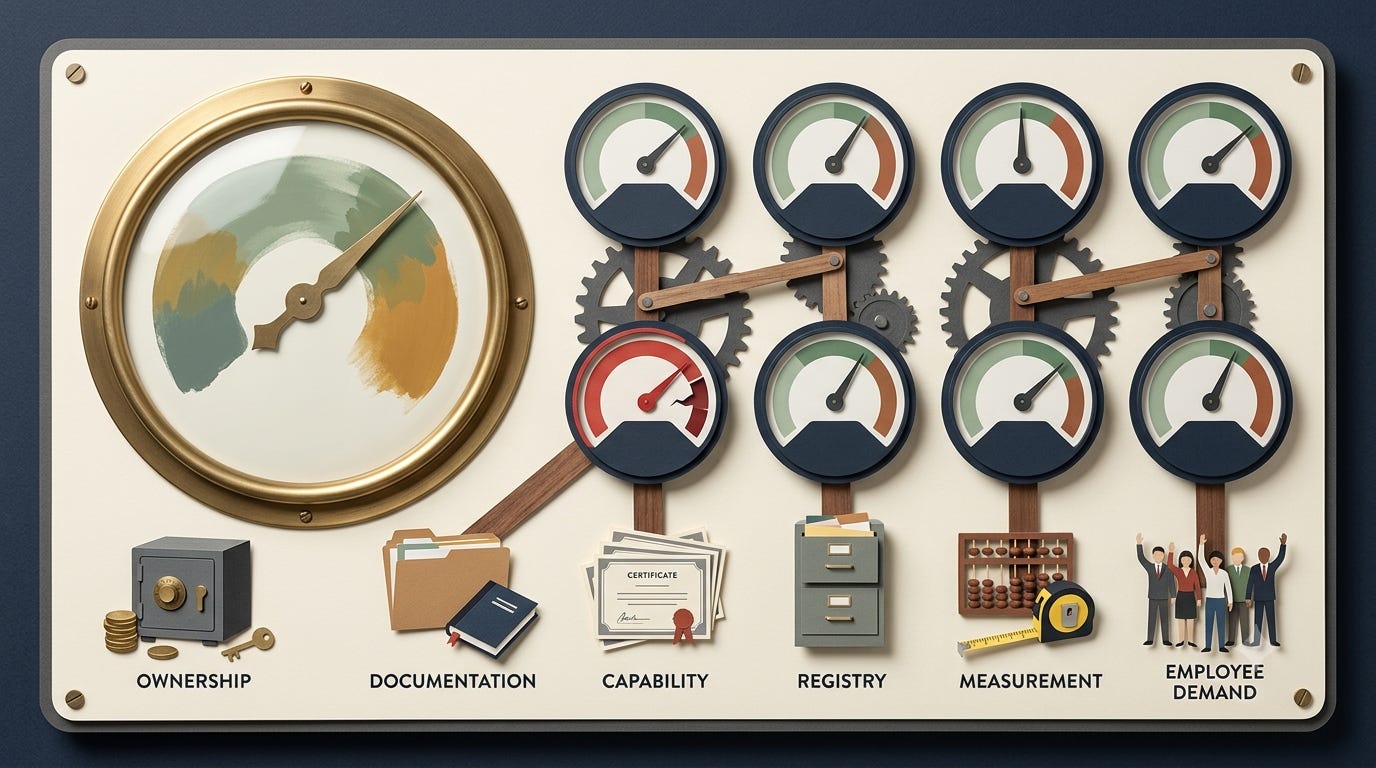
Then sit with the person who’d have to live with the answers and go through six of these out loud. All six want to be true at the same time, and to keep being true, which is the part that makes it a way of operating rather than a milestone.
Is there one name attached to the outcome here, with the method and the budget to act on it?
Could an agent run the core process from what’s written down today, and could a stranger tell what this company is for from a document?
Do these people build and maintain their own automations against a shared standard, and can their managers judge the output?
Could you produce a list of every build running in this organization, with a cost and a maintenance owner against each one?
Is there a baseline from before any of this started, and is something measured against it on a schedule?
Are people here bringing you problems to solve without being asked?
Six yeses and that function is running itself, and the next one gets cheaper because of what this one learned.
Anything short of six gives you a named condition that isn’t holding, which is a smaller and much more workable thing than a level on a ladder.
And it gives you something to put in the next board update that could turn out to be wrong. Which, for my money, is the only kind of claim worth making.
---
So. Which of the six would your company struggle with? Reply and tell me the one that made you wince.
References
McKinsey & Company. (2025). *AI at work but not at scale*. https://www.mckinsey.com/featured-insights/week-in-charts/ai-at-work-but-not-at-scale
McKinsey & Company. (2025). *The state of AI: Global survey*. https://www.mckinsey.com/capabilities/quantumblack/our-insights/the-state-of-ai
RSM US LLP. (2026). *RSM’s cybersecurity special report finds middle market racing into AI faster than it can secure it*. https://rsmus.com/newsroom/2026/rsm-cybersecurity-special-report.html