


A leader I know recently took a new job running customer experience at a legacy industrial distributor, the kind of company that has been doing things the same way for a long time and is not in a hurry to explain why. One of her first stops was a regional office she’d never visited. She walked in, introduced herself, and a man near the door introduced himself back.
“I’m your four-day guy,” he said. “Retiring in four days.”
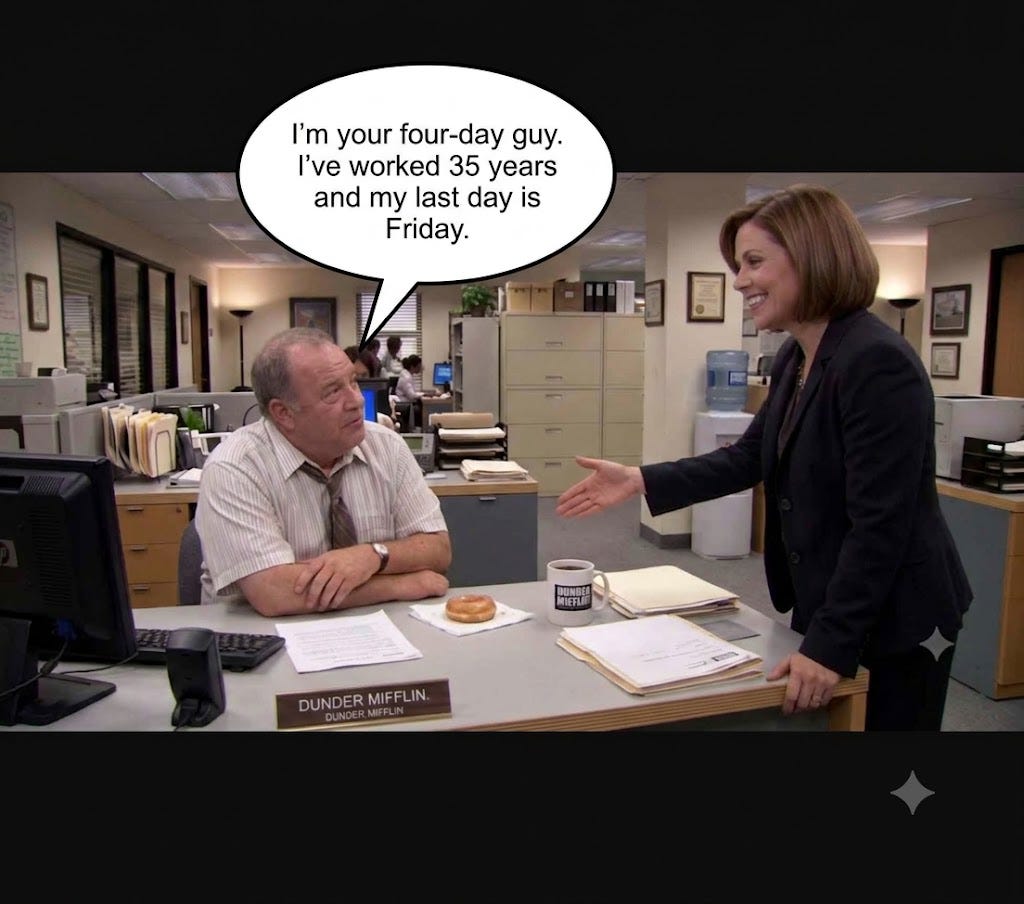
He had been there thirty-five years. He knew which customers actually meant it when they threatened to switch suppliers, which vendors would bend on price if you asked the right way, which piece of equipment always broke in August. None of it was written down. In four days, all of it would walk out the door with him, and the company would find out what it didn’t know exactly when it needed to know it.
Nobody in that story got replaced by AI. That’s the part worth sitting with.
The question everyone’s asking is the wrong one
Almost every conversation about AI and work starts from the same fear: is this going to replace me? It’s a reasonable question. It’s also the wrong one to spend your energy on, because it’s mostly out of your hands. The technology is going to do what it does regardless of how you feel about it.
The question that’s actually yours to answer is smaller and much more useful: now that some of the busywork can be handed off, what am I going to do with what’s left over?
That’s the whole game. Two people can have access to the exact same tool. One uses it to do the same replaceable work slightly faster. The other uses the freed-up hours to do something a machine genuinely can’t: read a room, catch the account that’s about to churn, write down what the retiring guy knows before he’s gone. Same tool. Very different five years from now.
What actually walks out the door when nobody’s watching
The four-day guy is not a rare case. Every organization has a version of him: the person who has absorbed twenty or thirty years of undocumented judgment and is on a countdown clock everyone can see coming, and mostly ignores.
This is where the AI conversation gets interesting, because the tool that could have helped here has almost nothing to do with replacing the four-day guy. It has to do with capturing what he knows before it’s too late to ask.
The customer experience leader I mentioned has a call and email platform sitting right now with an AI notetaking feature that’s never been switched on. Not because leadership doesn’t see the point. It’s because a half-broken rollout of a feature meant to build trust with customers is worse than no rollout at all, and she’d rather wait and do it right than launch something that embarrasses the team in front of the people they’re trying to serve.
That instinct is correct. It’s also exactly backward from where most of the fear in this conversation gets pointed. The risk was never “the machine takes my job.” The risk is “the knowledge that only exists in one person’s head disappears because nobody thought to point a tool at saving it while there was still time.”
The tech industry isn’t as far ahead as you think
There’s a specific kind of anxiety that shows up in legacy industries: the sense that companies like this one are hopelessly behind, while somewhere out there, sleek AI-native companies have it all figured out.
Here’s a story that should put that fear to bed. At a panel a few weeks ago, a moderator asked someone from a well-known tech company how her organization was actually using AI day to day. Her answer: she’d left herself a Slack message to reminder her about a task she needed to do the next day.
That’s not even using AI. That’s a to-do list with a basic automation and possibly better branding.
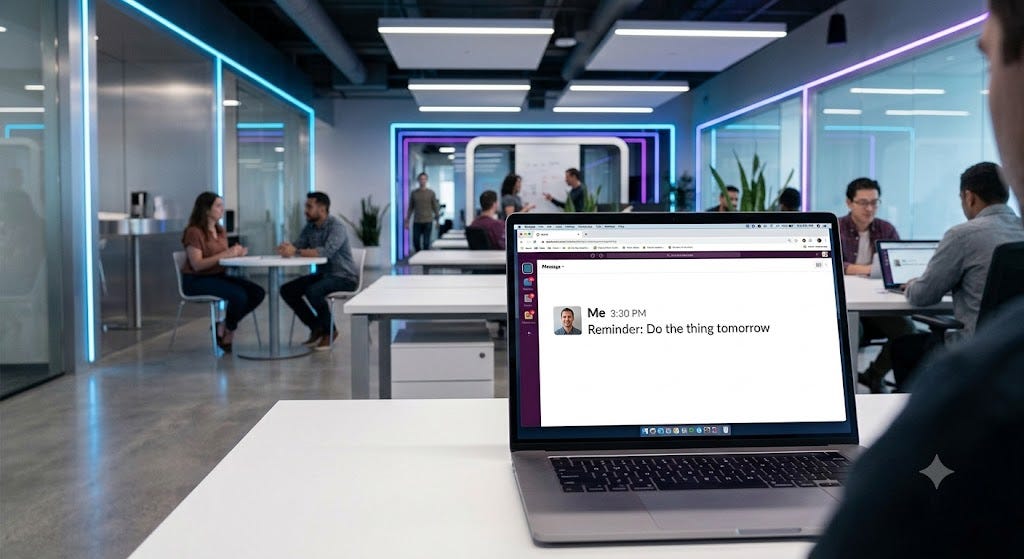
The person telling me this story took it as reassurance, and she was right to. If people working inside companies built on this technology are giving answers like that, then the gap between “behind” and “ahead” is much smaller and much fuzzier than it looks from the outside. Almost everyone is improvising. The organizations that end up ahead won’t be the ones who started with more certainty. They’ll be the ones who used the uncertainty to ask a better question earlier than everyone else did.
The only plan that survives contact with the pace of change
Ask most leaders for their five-year AI roadmap right now and you’ll get a shrug or a slide deck that’s already stale. The honest ones have stopped pretending otherwise. “I don’t think we can have a five-year plan,” the customer experience leader told me. “It’s: what are we doing this year, and what do we learn from it, and then we plan the next year.”
Given how fast the tools underneath everyone are shifting, a plan that only reaches twelve months out and gets rebuilt on purpose might be the only honest planning horizon available right now. It also happens to be the posture that keeps the real question in view: not “did we deploy the tool,” but “what did we free up, and did we spend it on something that mattered.”
Impact, not replacement, is the actual scoreboard
Nobody in this story is losing their job to a machine. The customer service reps aren’t being replaced, they’re being pulled off order entry, which nobody, not the customers and not the reps, ever found meaningful in the first place, and pointed toward the harder, better work of actually helping someone who doesn’t know what they need yet. The four-day guy isn’t being replaced either. He’s leaving on schedule, the way people do. The only question is whether anyone captured what he knew before he walked out.
That’s the reframe worth taking from all of this. AI was never going to be the thing that decided whether you stayed relevant. What you chose to do with the time and trust it freed up was always going to be the thing that decided that. Most people are still asking the wrong question. The ones who switch to the right one now get a real head start on everyone who’s still waiting to feel less scared before they move.
If you’re trying to figure out where the real impact is hiding in your own team’s busywork, that’s what the newsletter is for: subscribe at lab.workredesigned.co